

The GEO training market is a mess right now.
Yesterday, a friend sent me a Google document. The topic: how to do GEO for cross-border e-commerce.
He had paid $1,100 for a course. I opened the document he’d received.
I nearly fell off my chair.
Everything in it was backwards. Absolutely everything. It was a complete rip-off.
So let me walk through some fundamentals — with data sources — so you don’t go down the same wrong path.
Where AI Search Actually Stands Right Now
Let’s start with the current state of AI search.
Yes, AI search is growing fast. But its traffic share is still tiny.
AI-driven traffic currently accounts for less than 0.15% of total visits. Ahrefs sees an average of around 0.25%.
Here’s another data point: when Google displays an AI-generated summary in search results, the click-through rate on traditional search links drops from 15% (without AI summaries) to 8%.
But the click-through rate on the citation links inside those AI summaries? Only about 1%.
What this tells us: AI summaries do eat into clicks. That part is real.
But they are not the goldmine many people imagine. Users don’t finish reading an AI summary and then frantically click every cited link. Most of the time, they read the summary and leave. Or they search again.
So does that mean GEO is worthless?
No.
Because the value of AI search isn’t necessarily measured in direct traffic.
When someone asks ChatGPT, Perplexity, or Gemini “which product is better,” “how do A and B compare,” or “which tool is right for me,” they’re already in comparison-shopping mode. They’re not casually browsing. They showed up with a question. By the time they click through to your site — or go back to Google and search your brand name — AI has already done a round of analysis on you.
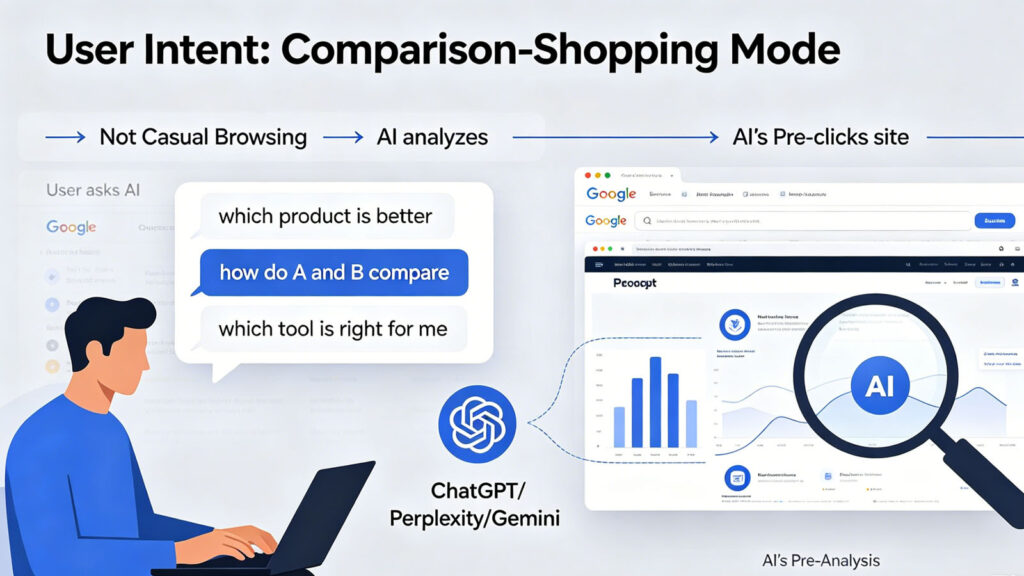
AI search traffic is still a trickle. But it’s shaping how people form opinions.
It won’t replace Google anytime soon. But it is quietly becoming a crucial link in the user’s decision chain.
What the Trainers Get Wrong
A lot of people package GEO as some kind of mystical technology.
The most common claims you’ll hear:
- Chop your content into chunks that AI can digest more easily.
- Use
llms.txt. - Add special Schema markup.
- Write dedicated AI-friendly Markdown pages.
- Create a whole batch of “AI-optimized” content.
Pretty much every training course says these things. But the reality is different.
Let me quote directly from Google’s official documentation:
I genuinely recommend reading this page — it’s remarkably clear.
Google states it plainly: the fundamentals of SEO still apply. You do not need to create new machine-readable files, AI text files, or special markup for these features. There is no special schema.org structured data to add.
Now, this doesn’t mean no AI platform anywhere will ever read certain files. But if someone tells you “just add llms.txt and you’ll show up in AI results,” or “GEO is all about special Schema,” or tells you to mechanically chunk your content —
Those people are wasting your time with bad advice.
So What Actually Works?
Let’s reframe how we think about this.
In traditional SEO, a lot of people fixate on keyword rankings. You target phrases like:
- best posture corrector
- best portable blender
- best dog bed for large dogs
You try to rank for that exact phrase. But AI search doesn’t work that way.
Google’s AI Mode has something called query fan-out.
Here’s what that means: when a user asks a question, the AI doesn’t necessarily search using that exact question. It breaks the question down into multiple sub-questions and searches for answers to all of them simultaneously.
Example. A user asks: “I want to buy a chair suitable for a programmer who sits long hours — any recommendations?”
In traditional SEO, you might target “best ergonomic chair.”
But the AI might break this into:
- How to deal with lower back pain from prolonged sitting.
- What are the key metrics for an ergonomic chair?
- Mesh vs. leather — which is better? What size fits someone who’s 180 cm tall?
- What options exist under a $200 budget?
- Which Amazon reviews are actually trustworthy?
- What do warranty policies look like? Is it suitable for a home office?
So the future of content is not about targeting a single keyword. You need to cover an entire cluster of questions around the user’s real decision-making process. Every sub-question is a lottery ticket. The more sub-questions you answer, the better your odds of being pulled into the AI’s final synthesized answer.
Cross-border sellers shouldn’t spend their days studying some magical file format. They should break down the questions real buyers ask before purchasing.
Say you sell pet supplies. Don’t just write “best dog harness.” Write about:
- How to choose a harness for different dog body types.
- Do no-pull harnesses actually work?
- What material is best for dogs with sensitive skin?
- Should you use reflective strips for nighttime walks?
- How to get a puppy comfortable with its first harness.
- Harness vs. collar — which is right for which situation.
This stuff looks basic. But it’s much closer to how real users ask questions. And that makes it far more likely to get surfaced by AI.
One More Critical Point About GEO
In traditional SEO, people care a lot about their official website, their blog, their backlinks. Those things still matter.
But in AI search, third-party content carries significantly more weight.
Review articles. Industry media. Reddit. Quora. YouTube comments. Forum discussions. Expert reviews. Real user feedback. All of these shape how AI understands a brand.
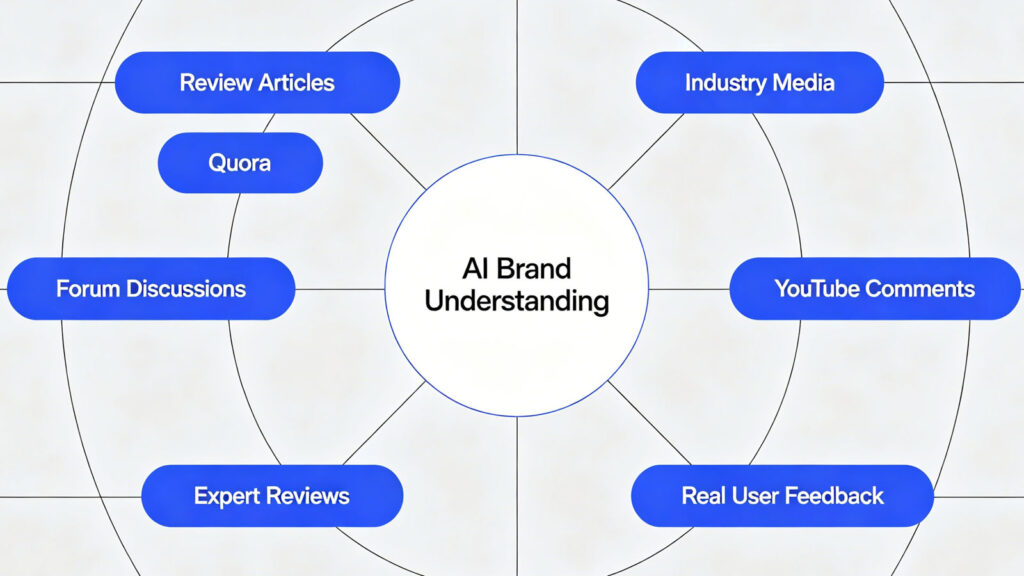
This is actually an opportunity for smaller brands.
You don’t necessarily need to beat the big players on page one of traditional search to get mentioned by AI. Some studies have found that a portion of the domains cited in Google AI Overviews don’t appear anywhere on the first page of traditional search results.
What this means: AI’s answer sources are not a one-to-one reflection of traditional rankings.
So for small brands, the play isn’t endless website optimization. You need people out there actually talking about you.
Find review sites. Find niche bloggers. Find real users willing to do comparisons. Go to Reddit, Quora, forums, YouTube — see what people are asking, complaining about, agonizing over.
AI doesn’t just check whether your brand was mentioned. It looks at context, source credibility, and semantic consistency. Fake signals look like signals in the short term. In the long term, they’re just noise.
If you’re serious about GEO, align three things: your product, your content, and the external conversation. Your website should say clearly who you’re for. Third-party reviews should confirm the same thing. User comments should surface the same use cases and pain points, over and over.
That’s far more valuable than fiddling with some llms.txt file.
Key Takeaways
1. AI traffic is tiny but commercially potent. Direct referral traffic from AI is negligible, but users are doing their decision-making and comparison-shopping inside AI tools. They convert later through brand searches or direct URL visits — conversions that are invisible to standard analytics and fall under hidden attribution.
2. AI search prioritizes external, authoritative content. AI-generated answers trust third-party validation: industry reviews, real user discussions, and other external signals. High-quality AI citation sources are often not the same sites that dominate traditional search page one.
3. AI-specific markup is mostly a solution in search of a problem. Custom AI text files, special structured data, mechanical content chunking — none of these optimization tactics have official backing. The core of AI search optimization is still foundational SEO: semantic clarity, crawlability, and indexability.
4. AI crawlers are more permissive but less forgiving. Compared to traditional crawlers, AI crawlers are more sensitive to complex frontend rendering, access restrictions, and CDN protections. If your core content can’t be crawled directly, it effectively doesn’t exist in AI search.
5. Content strategy is shifting from single-keyword targeting to query fan-out coverage. AI breaks a single user question into large numbers of sub-queries and synthesizes answers. The more granular sub-questions your content covers, the higher your probability of being cited and included.
6. The real optimization target is content absorption. The goal of GEO isn’t to make your site an AI reference source per se. It’s to ensure your core data, insights, methodologies, and comparison information can be broken down, absorbed, and incorporated into the AI’s final answer.
7. Structured, high-density content works better with AI search. Loose, sprawling, generic content is hard for AI to extract. Logically organized, modular, information-dense content blocks are far easier for AI to filter, select, and absorb.
8. Multimodal content is a core AI search asset. AI search can understand across text, images, video, and charts. The quality and diversity of your visual and multimedia content directly impacts your overall visibility in AI search.