
A funny thing happened over dinner last weekend.
I was catching up with a few old friends, and they’d brought along some of their own friends too — a mixed crowd. Halfway through the meal, the conversation landed on AI.
One friend said, beaming, that he’d used AI to make an anniversary card for his wife. Apparently it turned out so well it moved her to tears.
Another friend immediately shot back: “You should’ve built a whole project around it. Dump every story you have about you and your wife into it, let an Agent read through all of it, then write the card. That’s the real magic.”
Somehow the discussion veered into slide decks and research. Someone else declared that AI was basically useless — “It hallucinates constantly, just makes stuff up.” Someone else fired back: “It’s 2026, dude. Use a decent AI. That’s on you.”
And then the real arguments started. Everyone was convinced they were the one who really knew how to use AI.
I sat there listening, a little dazed. At some point I swear I could hear the table next to us also talking about AI — something about using it for studying and fact-checking, and someone explaining crawfish.
That dinner stuck with me.
Here’s the thing we all instinctively know: the same AI, the same Agent — different people produce wildly different results. But the real question is: where exactly does that gap come from? How do you measure it? Where are you on that spectrum right now? And what’s the next step?
People ask me all the time: “I want to learn AI — where do I even start?” I’ve always struggled to answer, because the question is enormous. There’s no clean starting line.
But after that dinner, an idea clicked.
What if I mapped this out like a game progression system? What if AI proficiency had actual levels?
I spent the next while mentally sorting through three years of observations — my colleagues, readers who leave questions in my comments, people I’ve talked to in all kinds of settings.
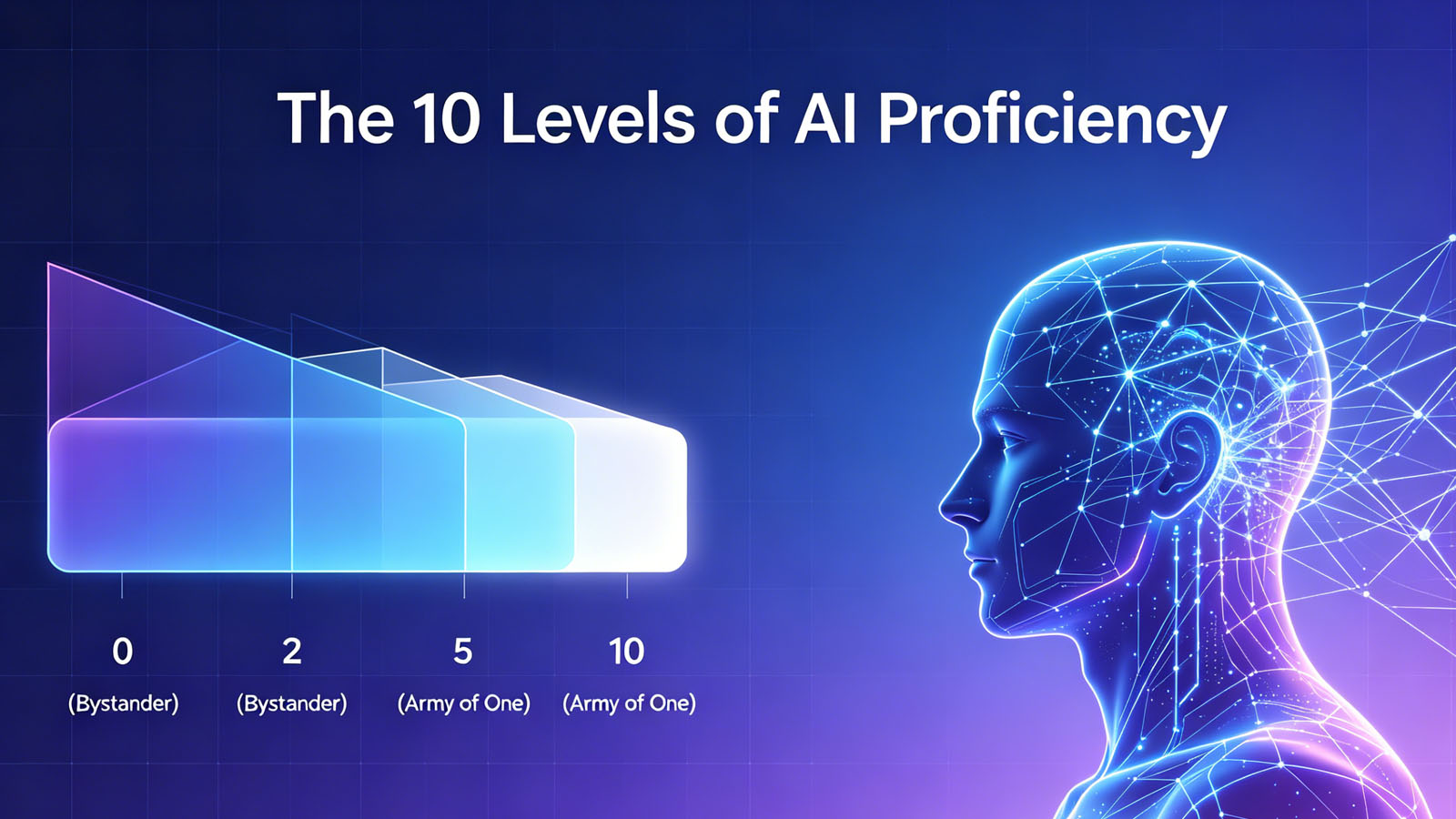
What emerged were four dimensions of progress. Together, they form 10 levels of AI proficiency.
The Four Dimensions
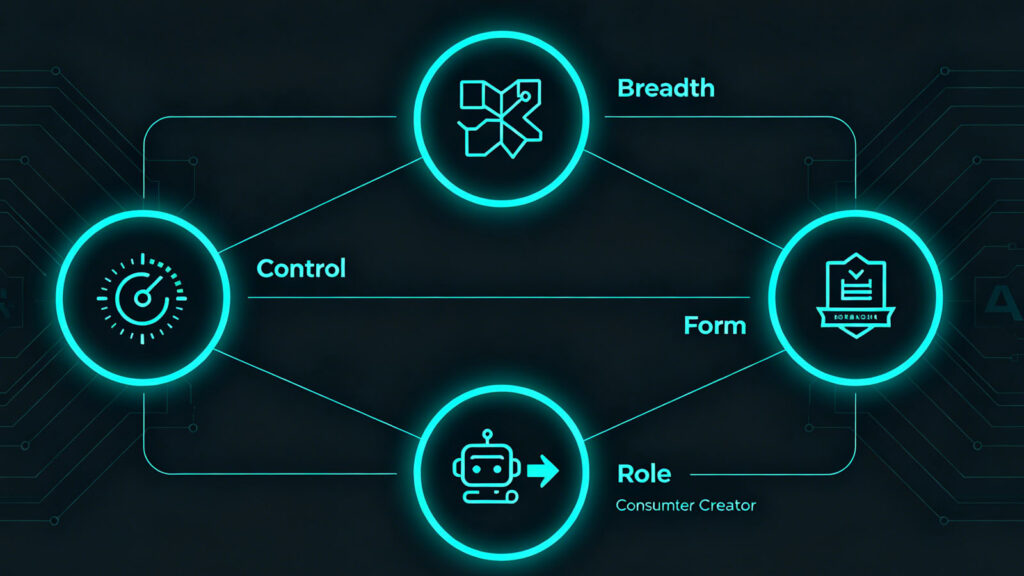
Control: You start out feeling like AI is random and unreliable — it rambles, it hallucinates. Over time, you learn how to constrain it, how to feed it the right context, how to design a harness that makes its output precise and predictable.
Breadth: At first, you only use AI within your own narrow domain. Then you start crossing boundaries — using it to explore fields you knew nothing about. You go from narrow to broad.
Form: You move from ChatBots to Agents. From one-shot conversations to long-running tasks that chain together.
Role: You shift from consumer to creator. From using other people’s prompts to building your own Skills.
These four dimensions don’t advance in lockstep. You might have high control but narrow breadth — perfectly dialed in, but only within your little corner. You might be all over the map in breadth but still stuck in consumer mode, never having built anything of your own.
But taken together, where you land on these four lines tells you roughly what level you’re at.
A disclaimer before we begin: this framework is my own way of categorizing things, built for the average AI user. It’s not about specialized professional domains. If you disagree with where you land, that’s fine — you’re probably right. And if someone in your life keeps asking you how to get better at AI, feel free to send them this.
Let’s go.
Lv. 0 — The Bystander
The Bystander knows the term “AI.” They’ve probably seen some headlines. But they have never actually exchanged a single message with a large language model.
This sounds like it’d be a small group if you’re reading this. It’s not. Around 80% of the world’s population is still here.
Getting to Level 1 is trivial. Don’t overthink which AI to use. Open your phone’s app store, search for ChatGPT, Claude, Gemini — whatever icon catches your eye. Download it. Open it. Ask it anything. Ask it what to wear today. It doesn’t matter.
Take that one step. You’re at Level 1.
Lv. 1 — The Dabbler
You’ve started. You’re using it.
The pattern is simple: “Write me a __” and wait for the result. You take whatever comes out. No follow-ups, no context.
“Write me an email.” “Summarize this document.” “Give me a proposal idea.”
You don’t ask follow-up questions. You don’t add background. You copy-paste the output and move on. If it works, great. If it doesn’t, oh well.
Your opinion of AI depends entirely on luck. Sometimes it seems brilliant; other times it’s useless, and you can’t quite articulate why.
At this stage, your experience of AI is hazy. Your habits aren’t established yet. You probably use exactly one app — most likely ChatGPT or Claude — and you don’t really care which model runs underneath, or even know that different models exist.
Honest assessment: at this level, AI is just a slightly fancier search engine. You know how to search. You don’t yet know how to ask.
Lv. 2 — The Conversationalist
Something is starting to click.
You’ve realized that how you ask matters more than what you ask.
When the AI gives you a bad answer, you no longer close the tab. You push back: “No, that’s not what I meant. What I need is…” You add context. And suddenly, the output gets noticeably better.
You’ve watched some YouTube videos, read some Twitter threads. You’ve learned to say things like “You are a…”, “Use the tone of…”, “Keep it short.” You now know this thing has a name: Prompting.
Then you stumble onto something interesting: when you give the AI some reference material to work with, the quality of its output jumps dramatically.
By now, you’re using AI regularly in two or three work scenarios — maybe writing weekly reports, polishing copy, or translating documents.
But you still can’t fully stop it from making things up. Your go-to fix is beautifully simple: ask the same question again, or ask a different AI the same question, then compare which answer looks more plausible.
You’ve stepped onto the first rung of the Control dimension. You’re beginning to sense the word “constraint” — even if your constraints are still crude.
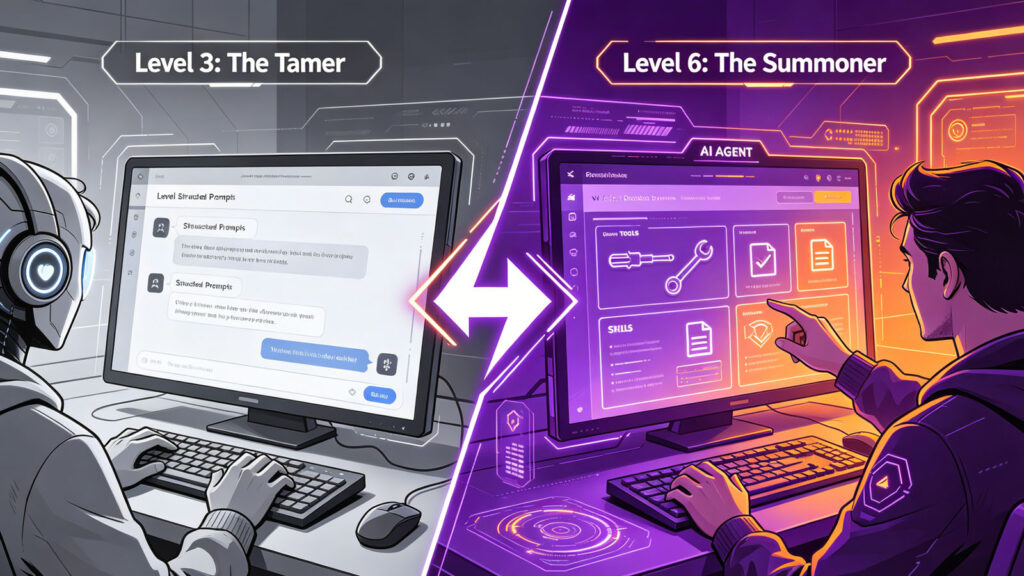
Lv. 3 — The Tamer
This is the first real dividing line.
Congratulations — you’ve now surpassed roughly 70% of people.
After enough trial and error, something in your mind unlocks around the idea of constraint. You start proactively setting rules for the AI.
You add lines to your prompts like: “If you don’t know, say so — don’t make things up.” “Provide source links.” “Mark any uncertain parts with [speculation].”
You now know when to toggle deep reasoning on. Math and complex logic? Always. Casual chat? Leave it off.
You’ve figured out how to make AI more obedient. You feed it context, give it examples, break tasks into steps. The output has gone from pure randomness to probably usable.
You’re writing structured prompts now — “Output in this format,” “Reference these three examples,” “Give me an outline first, let me approve it, then expand.”
You’ve noticed that different models have different strengths, so your tool stack diversifies. Claude for writing. Gemini for research. ChatGPT for brainstorming.
You iterate on AI output instead of abandoning it after one bad result like you used to. No more gacha pulls.
You’re using advanced features too — file uploads, web search, memory, custom instructions.
My sense is that a lot of people who think they’re pretty good at AI are at this level. And that’s fine — Lv. 3 already covers 80% of daily AI use cases.
But.
A lot of people stop here. Because the next level requires a genuine mental leap.
Lv. 4 — The Boundary Crosser
You start using AI for things outside your own expertise.
Congrats — you’ve now surpassed about 90% of people.
A marketer writing Python scripts. A software engineer drafting a business plan. A teacher designing posters.
You discover something genuinely exciting: all those things you used to need a specialist for? You can now handle a surprising number of them yourself, with AI.
Your capability radius expands dramatically.
You’re now using AI across five wildly different domains at once. You start actively seeking out different AI tools. Your stack balloons — five to ten tools, each mapped to a specific use case. And you start paying real money for subscriptions: ChatGPT Plus, Cursor, Midjourney, Runway, and more.
You also start helping people around you solve problems in their domains.
The signature phrase of this stage, spoken or just felt:
“I feel like I can do anything.”
That’s not exactly true — but the feeling is real. AI hands you a ticket into every room. You’re still a beginner in most of those rooms once you walk in. But you’re in.
Lv. 4 is the first real explosion on the Breadth dimension. Moving here from Lv. 3 requires crossing a mental chasm — and staying curious about the world.
Lv. 5 — The Weaver
At this level, you’ve stopped being someone who just “asks AI stuff sometimes.”
AI is now embedded in your daily workflow.
You have go-to prompts, go-to templates, go-to processes. AI has shifted from an occasional helper to a daily collaborator — someone you work alongside.
You’ve built a prompt template library. Similar tasks get similar workflows. You never start from scratch.
You’re learning to chain things together — breaking complex tasks into multi-step pipelines, with each stage handled by AI in a different way. You’re starting to think about encapsulating workflows into agents.
By now, you’ve realized that AI needs more context to truly understand you. So you start deliberately collecting data to build your own knowledge bases. You start using memory systems to manage long-term collaboration with AI.
Your signature behavior: you create separate projects for different things.
Writing has its own project, stuffed with past work, style guides, and reader feedback. Home renovation has its own project, with floor plans, budgets, and material quotes. Your kid’s learning has its own project — past mistakes, textbooks, teacher assignments, all fed in.
A key shift happens at Lv. 5: you are no longer purely using AI. You are designing the way you and AI work together.
You’re developing your own methodology.
And later, when you first hear the term “Context Engineering,” you’ll have a brief, disorienting moment of recognition — as if everything you’ve been doing has a name after all.
Lv. 6 — The Summoner
This is the level where you finally cross the threshold from ChatBot to Agent.
You’ve now surpassed roughly 97% of people.
You are no longer satisfied with chatbots. You’ve discovered that sitting on top of those conversational AIs is something much more powerful: Agents.
You start using Claude Code, OpenClaw, or similar Agent-based tools. And you have your first genuinely different experience — AI that doesn’t just respond to your questions, but directly interacts with your devices to get work done.
It reads files. Writes and edits code. Operates your computer. Calls external tools.
You start encountering concepts like MCP, Skills, and tool calling. You understand the fundamental difference now: an Agent can execute multi-step plans, invoke tools, and make decisions autonomously.
You enthusiastically install dozens of Skills into your Agent. At some point you glance at the list — nearly a hundred of them — and feel deeply satisfied that your Agent is becoming increasingly capable.
You might build your first complete little product with AI — a webpage, a tool, an automation script, a Chrome extension.
Honestly? I think the leap from ChatBot to Agent is the single most stunning experience across all ten levels. It doesn’t just change your efficiency. It rewrites your entire mental model of what AI can do.
You also start learning how to work with your Agent. And you realize — Agents are a lot harder to steer than ChatBots.
Lv. 7 — The Forger
At this stage, you begin learning how to design Agents.
And you realize: it’s time to start creating your own things.
“I’ll wrap that into a Skill” becomes one of the most common sentences in your vocabulary.
You now have a handful of tools and Skills that are entirely your own — things you built yourself. A writing Skill you use for every article. A customer-service Agent that auto-responds to buyer inquiries. A CLAUDE.md. A weekly workflow that runs on autopilot.
You learn how to design an AI feedback loop: AI produces, AI checks its own work, the feedback feeds back in, AI iterates, checks again, iterates again. Once that loop starts spinning, the quality of your output begins approaching — and sometimes exceeding — professional-level work.
You start investing in infrastructure to save time next time.
You tear down your entire local file system and rebuild it. You restructure your file management from scratch. You cut your Skill collection from nearly a hundred down to under thirty, ruthlessly. You start studying how to turn everything you do into a repeatable process.
Your first attempt at a new task might take longer than someone at Lv. 3 — because you’re busy building Skills, writing code for automated workflows, designing systems. But the second time that task comes around, it’s fast. Sometimes you don’t have to lift a finger.
This is the compounding curve of the AI era.
Lv. 8 — The Creator
At this level, you start to genuinely feel the pleasure and rush of creation.
You’ve probably surpassed 99% of people.
And something interesting happens at Lv. 8.
Creators begin to fork into two paths.
The technical creators. They go deep on coding — Claude Code, Codex, and similar tools — building business workflows, pipelines, and software. They use Skills to connect data sources and tools into a personal AI workstation. They design multi-agent collaboration flows where different AI roles handle different parts of the work. They start building AI infrastructure for teams or organizations: knowledge bases, Skill libraries, automated pipelines.
And they start using AI to code their own products.
The artistic creators. They go deep on video, short films, and visual work. They use tools like Runway, Kling, and Seedance to produce content that once required an entire production team. They study AI-assisted storyboarding, editing, color grading, and scoring. The work keeps getting better — and some set their sights on feature films.
There are also rare, impressive people who walk both paths simultaneously — shipping products people love while taking home awards at film festivals.
But whichever path they choose, Lv. 8 creators share one trait: you can no longer tell where work time ends and AI time begins, because AI is involved in almost everything.
AI is no longer a tool. It’s how the work gets done.
And from here, the four dimensions all begin to max out. Control, Breadth, Agent capability, Creator identity — all converging. They start to fuse into a single thing: a new kind of person.
Lv. 9 — The Awakened
The four lines have merged.
AI has become part of how you think.
You are now among the 0.01%.
AI is no longer a tool you reach for. It’s woven into your cognition. When you encounter any problem, your first instinct isn’t “How do I do this?” but “How do I and AI do this together — in the best possible way?”
Your entire creative process is natively human-machine collaborative. AI is involved from the ideation stage, not brought in after you’ve already figured everything out.
Your way of working has become hard to explain to people who don’t use AI. Not because it’s complicated — but because the underlying assumptions are completely different. It’s like trying to explain why you need a second monitor to someone who’s never used a computer.
You create methodology. You create tools. You create new paradigms for how work gets done — and you influence how other people use AI.
You’ve stopped worrying about whether AI will replace humans. Your own way of working has already demonstrated a form of human-machine symbiosis.
Lv. 10 — The Army of One

The final level.
After long enough with AI, you undergo an identity shift.
If we rewind the clock three years and look at your output — your actual ability to produce things — the unit of measurement no longer fits. You can no longer be measured in “individuals.”
One person, simultaneously doing content, product, design, operations, data analysis, business strategy.
Not at Lv. 4 “I kind of know a little” levels either. Each output is near-professional quality.
Because you’ve learned to project your judgment and your taste through AI into every domain.
You have your own Skill library. Your own prompt methodology. Your own Agent workflows. Your own knowledge systems. Your own aesthetics and taste.
Together, these form a new version of you.
When a new task arrives, you don’t start learning from scratch. You plug the task into your system. The system absorbs the unfamiliar domain knowledge. Your job is to make the judgments.
Writing an article? AI handles research, the first draft, formatting. You handle the angle, the final polish, and the taste.
Building a product? AI writes the code, does the design, runs the data. You define what problem the thing is supposed to solve.
Making a business decision? AI exhaustively lists options, runs simulations, compiles competitive research. You make the incalculable judgment call that sits on top of all that information.
What’s the fundamental logic behind a company?
Companies exist because one person can’t do everything. You hire people. You divide the labor. You manage. The organizational form we call a “company” has been solving exactly one problem since the Industrial Revolution: the inherent limits of individual capacity.
But when AI drives the marginal cost of execution to near zero, that premise starts to crumble.
One person — with good enough taste, strong enough judgment, and a carefully constructed AI system — can now produce at a level that, in an earlier era, would have required a team of dozens.
Coda
When we stand at Lv. 10 and look back at the entire path from Lv. 0 through Lv. 9, something interesting emerges.
From Lv. 0 to Lv. 9, the question was always: How do I get better at using AI?
But at Lv. 10, the question shifts.
It becomes:
Who do I want to become?
When AI flattens the execution playing field, a hundred people using the same AI tools will still produce output that varies by a factor of a hundred.
The gap doesn’t come from the tools. It doesn’t come from the techniques. It doesn’t come from who wrote the fanciest Skill.
It comes from what’s inside that person’s head.
How they understand the world. Their aesthetic sensibility. Their hierarchy of value. Their sense of what’s good.
AI can’t give you those things.
The endgame of tool democratization is, paradoxically, human inequality.
I’m not trying to make anyone anxious. But I do want to say this: AI is evolving incredibly fast. It’s not a skill you learn once and set aside. It keeps changing — and so does your relationship with it.
So in this chaotic era, figure out who you want to become.
Then move forward.
Don’t look back.