
If you run an independent site, backlinks aren’t optional. Fiverr is convenient, sure — but the quality is all over the place. PBNs, scraped guest posts, the same domain sold to dozens of buyers. The odds of burning money are high.
The five platforms below are ones I’ve either used firsthand or vetted extensively. These aren’t summaries cobbled together from landing pages and press releases. I’ve filtered through site inventories, placed orders, and evaluated actual delivery quality.
What qualifies a platform for this list:
- Verifiable traffic. Ahrefs or Semrush data backs it up. No “zombie domains” with inflated DR and zero organic visitors.
- Manual placements, not automation. Bulk publishing leaves a footprint Google can spot immediately.
- Transparent metrics. Clear pricing and open site data. No black-box curation.
The platforms are ordered by use case, not price.
1. PRPosting — Best for Multilingual Backlink Building
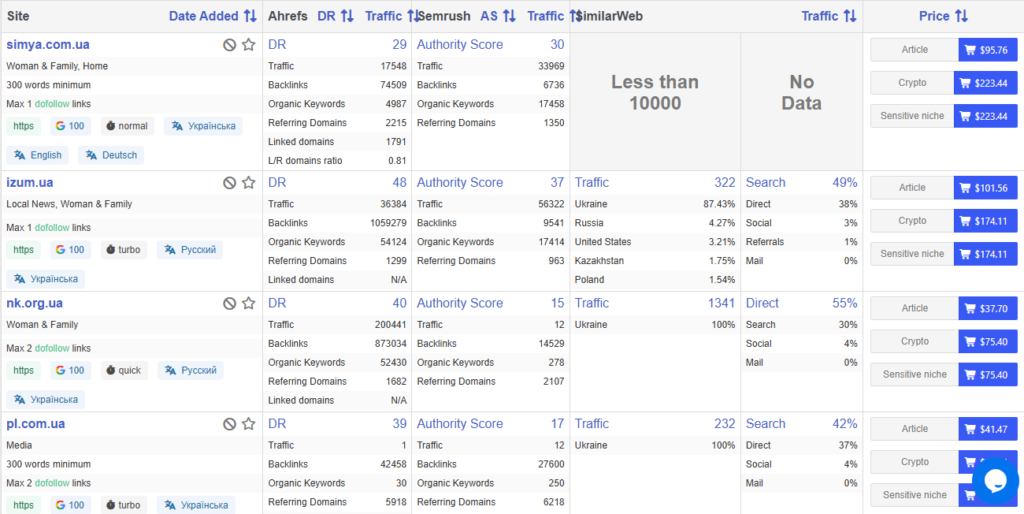
PRPosting is a guest post marketplace with close to 40,000 sites across 100+ countries. Its real edge isn’t scale — it’s depth across languages. English, Spanish, German, French, Polish, and more. If your SEO strategy spans multiple regions, this is where PRPosting shines.
The platform pulls in Ahrefs DR, Semrush, Moz DA/PA, and Majestic TF/CF metrics, with filters granular enough to narrow by DR, traffic, language, and niche. All placements are manual — no automated bulk publishing. That matters for staying off Google’s radar.
You’ll want to vet sites yourself rather than relying on support. The platform does provide traffic source breakdowns — search vs. social vs. direct. That’s the data point that separates real traffic from bot-driven numbers. Low search share? Proceed with caution.
Best for: Site owners running multilingual SEO who need solid non-English link coverage.
2. Collaborator — Transparent Data, Built for Scale
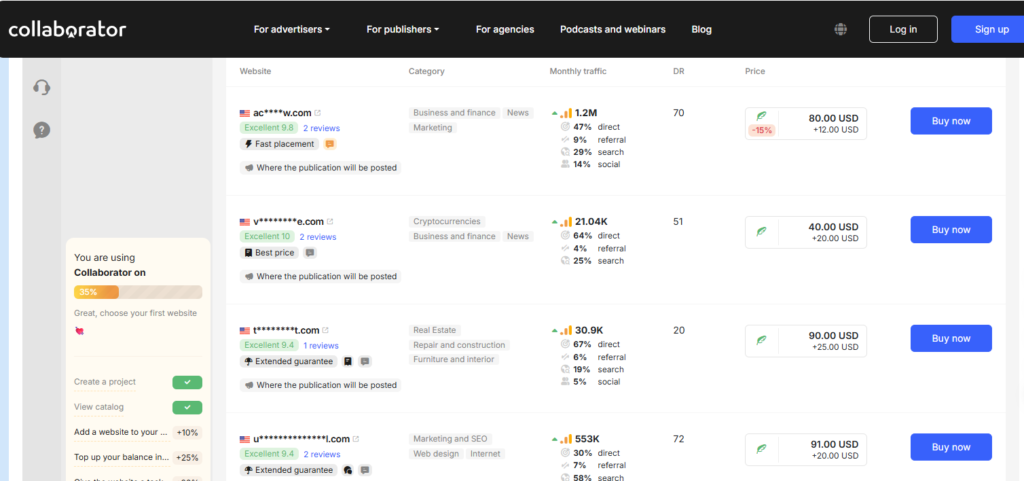
Collaborator is one of the largest link marketplaces out there, with 35,000–75,000 sites across 150+ countries. Pricing spans an enormous range — from $10 to $1,000+ per placement — so both lean budgets and enterprise spend have options.
It holds a 4.8/5 on G2, and users consistently point to two things: transparent metrics (Ahrefs and SimilarWeb are integrated directly, not estimated by the platform) and a mature dispute resolution process. When delivery issues come up at scale — subpar content, removed links — Collaborator’s refund and replacement flow is more reliable than most.
Best for: International sites entering the heavy link-building phase. With 35,000+ sites, you’ve got room to diversify anchor text and cover multiple niches.
3. Authority Builders — Real Traffic Verification, No Zombie Domains

Authority Builders takes a different approach to vetting: it only accepts sites with verified organic traffic. Plenty of marketplaces are flooded with domains that look great on DR — 70, 80, 90 — but check Ahrefs and the Organic Traffic line is flat. Those scores were manufactured with 301 redirects or PBN interlinking. Authority Builders filters them out entirely.
The trade-off is price: $150–$1,000 per placement, well above market average. But what you’re paying to avoid is the bigger cost — dropping money on a pile of links where none of them move the needle.
Best for: Competitive niches where a single link from a real, trafficked site is worth more than ten cheap placements from domains nobody visits.
4. ArticlesFactory — 50,000+ Partner Sites, Built for Link Diversity
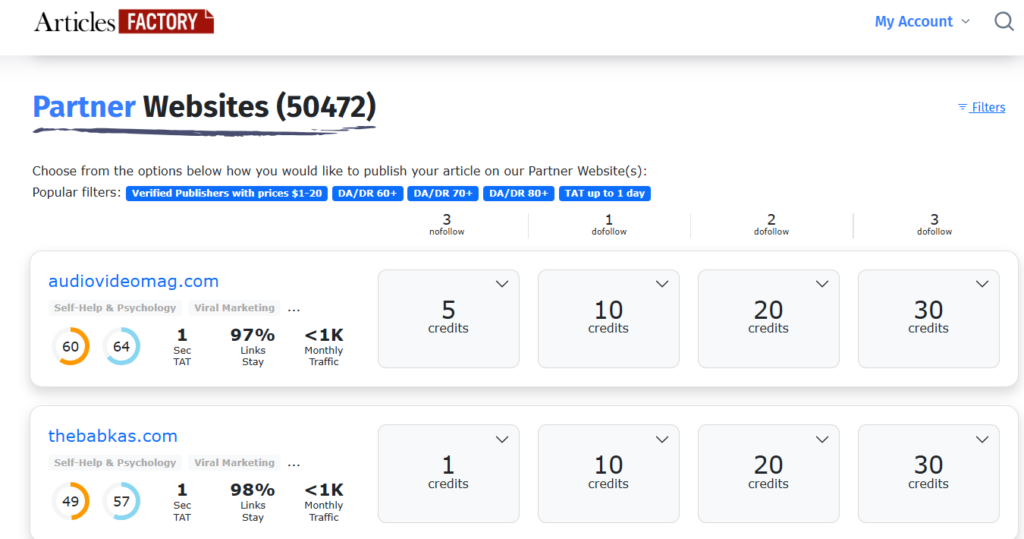
ArticlesFactory has been around for nearly two decades. At its core, it’s a link marketplace — you pay to submit articles, and they get published across a network of 50,000+ partner websites with your backlinks embedded.
A single ArticlesFactory placement won’t carry the SEO weight of a handpicked guest post on an authoritative publication. Its real value is scale and variety. Fifty thousand partner sites means niche coverage that’s exceptionally broad — general business, niche hobbies, and everything in between. A healthy backlink profile needs links from diverse source types. ArticlesFactory gives you that diversity more efficiently than a single guest post platform can.
Important: This is a supporting role, not your lead channel. The upside is volume, niche breadth, and low cost. The downside is individual site authority — it won’t match a manually vetted guest post placement.
Best for: Site owners on a budget who need to build a broad backlink base, or those with ample budget who need to round out link diversity — covering dozens of niches for a few dozen dollars looks more natural to Google than piling everything into one platform.
5. Featured.com — Earn Editorial Links With Expertise, Not Cash
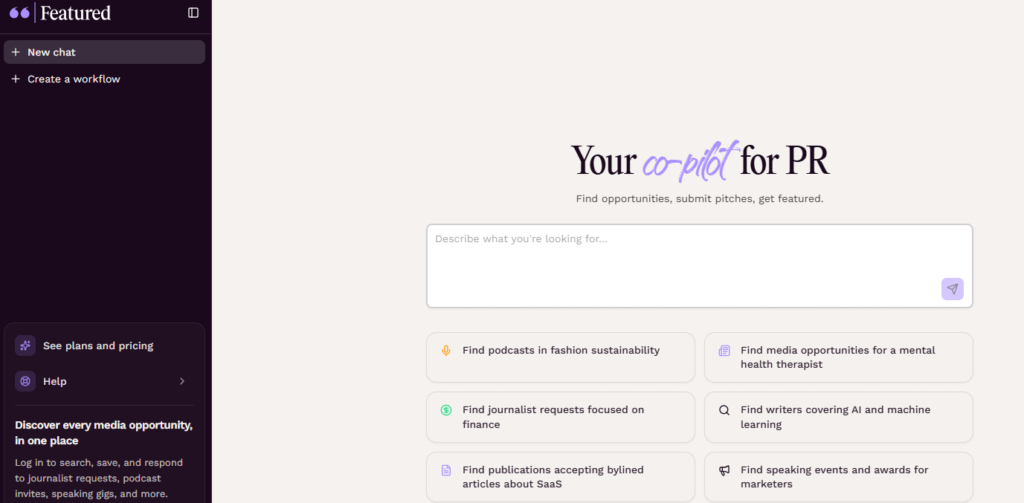
Featured.com operates on a completely different model from the four platforms above. You don’t buy links here. You earn media citations and backlinks by contributing expert insight.
Here’s how it works: journalists and editors post questions on the platform (“What are the top SEO trends for 2026?” “How should independent sites approach conversion rate optimization?”). You submit an answer as a subject-matter expert. If selected, your quote appears in the published article with your name and a link back to your site. Featured acquired the legacy PR platform HARO in 2025 and is now the dominant player in this space.
The publications active on the platform include Entrepreneur, Forbes, Inc., and Fast Company. Editorially earned links like these carry the most weight in Google’s eyes — not because of raw DR numbers, but because an editor choosing to cite you is a genuine trust signal.
These aren’t paid links. Whether you get a link at all, and whether it’s dofollow, is up to the publisher. Free-tier users sometimes end up with a brand mention and no link. And your answers need to hold up — the platform runs AI detection, and AI-generated responses won’t make it past editorial review.
Best for: People with real industry expertise who are willing to invest time writing useful insights. Featured is complementary to PRPosting or Collaborator — use those for targeted placements, and Featured for editorially earned citations.
Mistakes to Avoid When Buying Backlinks
Whichever platform you choose, these five principles will save you money:
- Don’t buy links from high-DR sites with zero traffic. DR can be gamed. Check Organic Traffic in Ahrefs or Semrush — a link from a site nobody visits is worth close to nothing.
- Look at traffic sources, not just traffic volume. If a site gets 70% of its visits from direct or social and almost nothing from search, it has no real search presence. A link from that domain won’t help your rankings. PRPosting and Collaborator both surface this breakdown.
- Diversify your anchor text. Brand names, naked URLs, generic phrases (“click here,” “learn more”), and exact-match keywords should all be in the mix. Using the same anchor text everywhere is the fastest way to signal manipulation to Google.
- Start with one or two test orders. Never go big on a first purchase with any platform. Test delivery quality, communication speed, and link survival rate. Scale up only after you’re satisfied.
- Spread your budget across platforms. When your entire backlink spend goes through a single marketplace, the pattern looks unnatural. Use two or three platforms together for source diversity.
Backlink Building Strategy
The most effective approach uses all five platforms. Start with a primary guest post marketplace — PRPosting or Collaborator, depending on your language needs. Layer in ArticlesFactory for broad, diverse niche coverage. Add Featured.com for editorially earned citations. If budget allows, top it off with a few premium placements from Authority Builders. Total spend can range from $50/month to $500+/month. The key is not putting all your money in one place.
Fiverr works for testing the waters with a few links, but it shouldn’t be your primary channel. The risk-to-reward ratio is terrible at scale. The same budget, spent on a marketplace where you can see real metrics and pick your own sites, goes a lot further.