
AI coding tools went through three phases in three years. Once you see this trajectory, you’ll understand what Claude Code is really doing differently.
In 2022, GitHub Copilot arrived. You’d type half a line, it would guess the rest. Like an intern sitting next to you — faster typing, sure, but the dynamic hadn’t shifted: you were still the one writing code.
In 2023 and 2024, Cursor took off. You could use natural language to modify functions and refactor modules. No need to specify how to write something. Just describe the effect you wanted. Later versions added Agent mode — cross-file operations, automatic command execution. But Cursor was born in the IDE and stayed there: an editor extension.
In 2025, Claude Code launched. It doesn’t live in any editor. It runs directly in the terminal. You describe what you want. It plans the steps, reads the code, writes the code, runs tests, operates git — the entire loop, autonomously.
Your role shifted from the person writing code to the person giving direction.
Three phases, and the change isn’t about technological sophistication. Copilot was your autocomplete. Cursor was your pair programmer. Claude Code is your independent engineering team. The relationship between you and AI changed.
What’s Actually Different From Cursor
This is the question I get most: “Cursor has Agent mode now. Isn’t it all just AI writing code?”
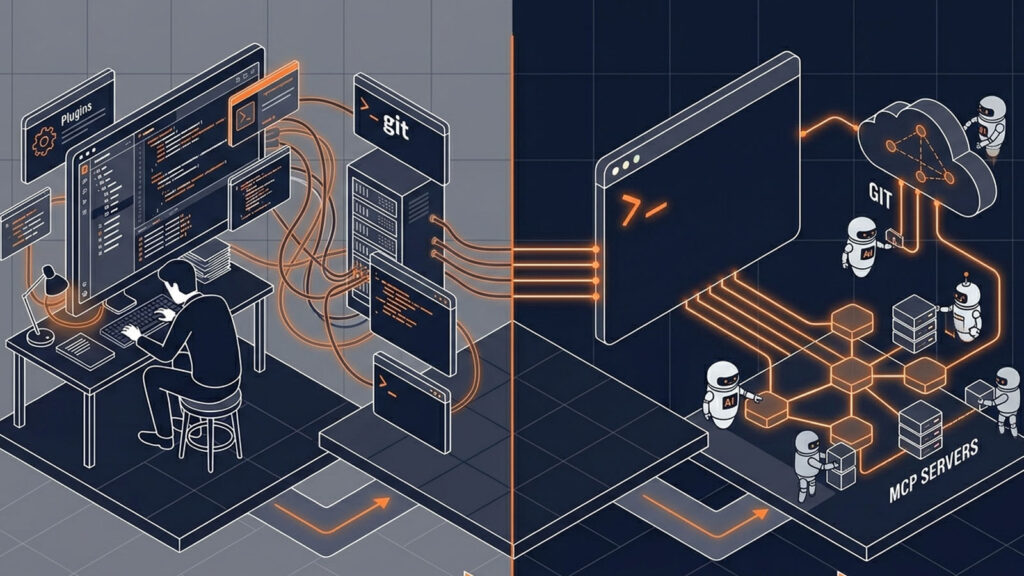
Fair question. Cursor post-2024 is genuinely powerful — cross-file awareness, project-level understanding, automatic command execution. The difference between the two isn’t about capability. It’s about degree.
| Dimension | IDE Agent (Cursor, etc.) | Terminal Agent (Claude Code) |
|---|---|---|
| Environment | Embedded in editor, depends on IDE framework | Terminal-native, direct OS access |
| Autonomy | Usually needs you watching and confirming | Can run fully unattended |
| System Integration | Bridges git/CLI through plugins | Direct git, shell, MCP operations |
| Memory System | Implicit project indexing | Explicit CLAUDE.md memory file |
| Parallelism | Primarily single-instance | Native multi-instance parallel |
Pay attention to the last two rows. CLAUDE.md lets you encode project knowledge, coding standards, and architectural decisions into a file. Claude Code reads it every session — giving the AI persistent project memory. Multi-instance parallelism means running several Claude Code instances simultaneously, each on different modules, like a small team.
Here’s the analogy: Cursor is like a pair programmer sitting at your IDE, both of you looking at the same screen. Claude Code is more like an independent engineer — you tell them the requirements, they pull the code, write it, test it, commit it. You go grab a coffee and come back to results.
Claude Code’s creator Boris Cherny says he hasn’t handwritten a single line of code since using Opus 4.5. He used it 46 out of 47 days. His longest single session ran for 1 day, 18 hours, and 50 minutes. That’s not marketing. That’s a reality happening at scale.
I’ve verified this myself: building every product without writing a single line of code by hand. Claude Code has turned “building products without knowing how to code” from a niche experiment into a mainstream possibility.
It’s Not Actually About Writing Code
This sounds counterintuitive, but it’s the biggest insight after six months of use: Claude Code isn’t helping you write code. It’s helping you build products.
Traditional AI coding tools optimize for code production efficiency — how to write this function or that component faster. Claude Code optimizes for product building efficiency — how to go from an idea to something running, faster.

Two scenarios side by side.
The way that works. With Claude Code, you say:
“Build me a Markdown blog system with Next.js, deploy to Vercel, support dark mode and RSS.”
It analyzes the requirements → chooses the tech stack → creates the project → implements step by step → runs tests → fixes bugs → done. Your job is to confirm and steer.
The way that drains you. With IDE-based agents, the experience isn’t terrible. But you’ll probably find yourself: watching the IDE to see what changed → manually rolling back when something breaks → the agent hesitates to run commands without your approval → you’re always the person sitting next to it. You’re the supervisor.
In the first scenario, you’re making product decisions. In the second, you’re supervising a process. As AI capability continues to improve, “watching AI work” will become less valuable. Product decision-making will become more valuable.
Claude Code’s rapid growth makes sense when you see the real demand it hit: a huge number of smart people want to build things. What they lacked wasn’t ideas — it was the ability to turn ideas into products.
How Fast Is It Growing
A few numbers.
Claude Code launched as a research preview in February 2025 and went GA in May. Within six months of GA, it reached a $1 billion annualized revenue run rate. That pace is exceptionally rare in SaaS history.
Enterprise adoption is fast too. Netflix, Spotify, DoorDash, Notion, and Vercel are all using it internally at scale. Anthropic’s data shows teams using Claude Code see an average productivity boost of 2x to 5x.
Claude Code currently runs on three models: Opus 4.6 (strongest reasoning, for complex tasks and architectural decisions), Sonnet 4.6 (best cost-performance ratio, the daily driver), and Haiku 4.5 (fastest response, for simple queries and completions).
The signal behind all these numbers is one thing: agentic programming is no longer a hacker’s toy. It’s becoming the standard way to build software.
What This Series Will Give You
No matter who you are, this series assumes you’re smart — but possibly new to AI coding tools.
Engineers who want a 10x efficiency boost. You already know how to code, but too much of your day goes to boilerplate, debugging, test writing, and CI/CD. Claude Code absorbs all of that, freeing you to focus on architecture and product thinking.
Product managers who want to build their own MVPs. You have product intuition and user insight, but you’re constrained by dev resources. Claude Code lets you ship a working prototype in a weekend — no sprint planning, no PRDs waiting for an engineer to interpret them.
Founders who want to run a one-person company. You want to validate a business idea without burning money and time on engineering. Claude Code gives one person the development capacity of a small team — websites, apps, backend APIs, all doable solo.
The entire series follows one thread: how a smart person goes from zero to building products with AI, in about a week.
| Phase | Articles | What You’ll Learn |
|---|---|---|
| Day 1: Onboarding | Part 1 – 3 | Understanding AI coding → Installation → Your first project |
| Day 2–3: Core | Part 4 – 6 | Mastering workflows → Configuring the memory system → Communicating effectively |
| Day 4–5: Advanced | Part 7 – 8 | Extending capabilities (Skills/MCP) → Multi-agent collaboration |
| Day 6–7: Build | Part 9 – 10 | Building a complete product independently → Developing a long-term mental model |
Every article includes hands-on sections you can follow along with. Don’t feel pressured to read straight through — read one, practice one, come back for the next. In the next article, we’ll spend 10 minutes getting Claude Code installed.