
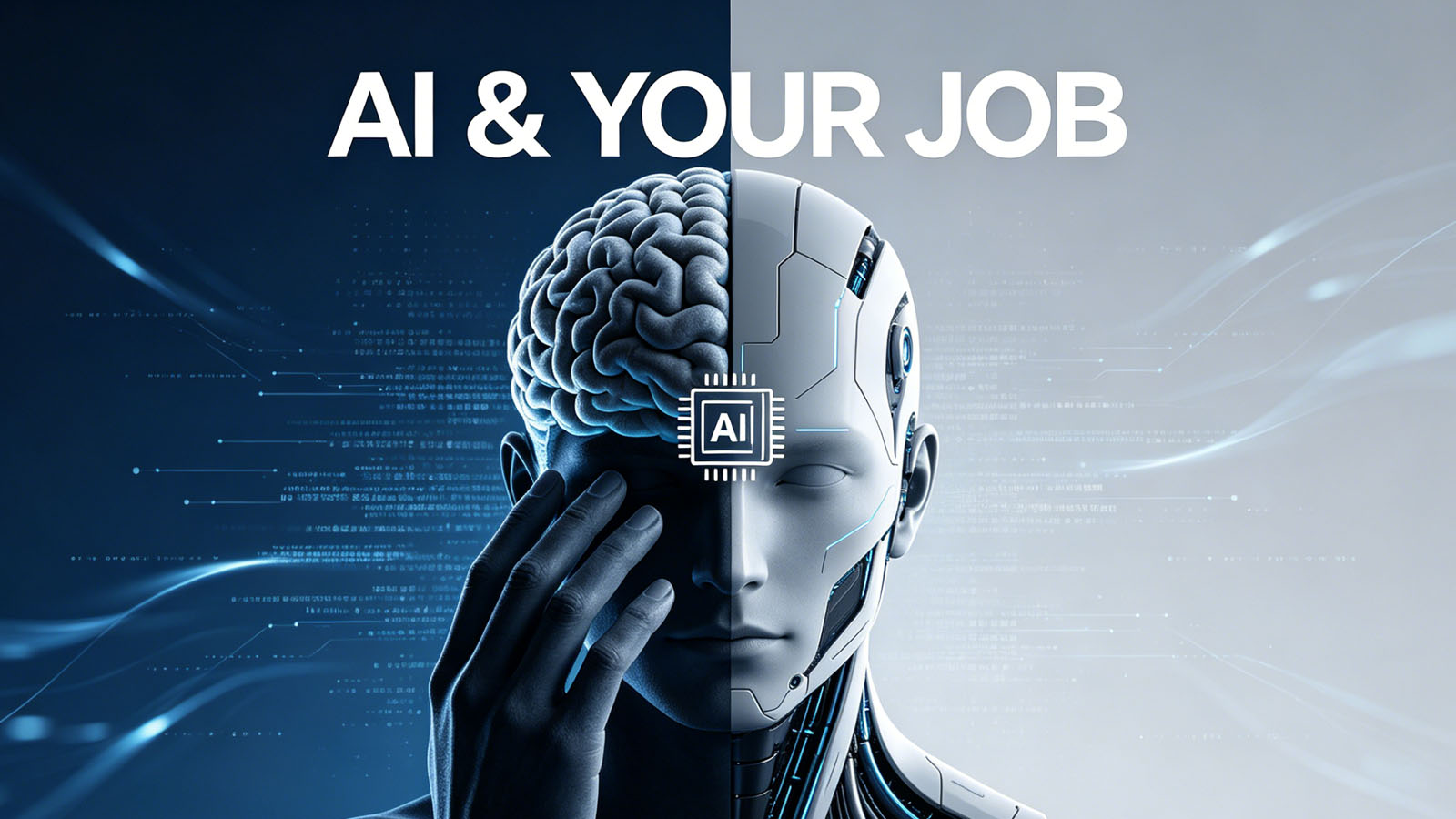
A wave of anxiety is crashing over professional communities. Online forums are flooded with discussions about AI-driven job displacement, with comments predicting the demise of entire fields: “Graphic designers are finished,” “The translation industry is over,” “Programmers are next.” The panic is palpable. While the technology is undoubtedly powerful, this fear is fundamentally misplaced. The core of the conversation shouldn’t be about how capable AI is, but about the irreplaceable value you bring to the table.
In essence, it’s a question of competition. Your competitor used to be the person at the next desk or a rival firm. Now, a new player named “AI” has entered the arena. The real question isn’t “Will AI replace me?” but rather, “How much of my work can AI replicate?“
The Inevitable Shift: When Execution Becomes Commoditized
Let’s be brutally honest. If the tasks that constitute 80% of your role can be performed by an AI at an 80-90% competency level, and that’s roughly your own performance level, your position is indeed vulnerable. The arithmetic is simple for any business leader: AI doesn’t take sick leave, demand benefits, have emotional ups and downs, or require sleep. It’s a 24/7 worker with near-zero marginal cost. From a pure efficiency standpoint, the writing is on the wall for highly repetitive, purely executional roles.
AI is rapidly encroaching on functions like:
- Basic translation and copywriting
- Formatting and layout
- Rudimentary graphic design
- Data entry and simple analysis
- Entry-level coding and script generation
The panic many feel, however, is misdirected. The true cause for concern shouldn’t be the arrival of AI, but the realization that after several years in a field, your output is comparable in quality to that of a machine. This is the real alarm bell. If you’ve been a translator for five years and an AI tool can match your work, the issue isn’t the technology—it’s what tangible skills and judgment you’ve accumulated in that time. Work without a moat, without compounding expertise, and without a unique human element was always susceptible to cheaper alternatives. AI is merely accelerating that inevitable process.
The Human Edge: Judgment, Strategy, and Complex Understanding
Here’s the crucial counterpoint: if your work requires nuanced judgment, a deep understanding of human psychology, accumulated experience, or decision-making in complex, ambiguous situations, current AI is nowhere close to being a threat.
I run a small team, and we use AI for virtually everything in our workflow. AI drafts English articles. AI generates image assets. AI assists with keyword clustering and analysis. I recently had an AI model generate 1,500 potential content category directions—a task that previously would have taken a person a week—in under half an hour.

But AI cannot do any of the following:
- Determine which of those 1,500 categories are commercially viable.
- Identify which keywords hold real strategic value.
- Pinpoint market niches with weak competition.
- Design the monetization pathway for an independent website.
This perfectly illustrates my core thesis: AI is an execution engine, not a judgment engine. It can multiply your efficiency tenfold, but it cannot tell you if you’re running in the right direction. Without sound strategic direction, phenomenal efficiency is worthless.
The roles that remain firmly in the human domain for the foreseeable future are those requiring synthesis and sophisticated cognition:
- Operations and Strategy
- Marketing and Brand Positioning
- Business Development and P&L Judgment
- Client Relationship Management
- Team Leadership and Mentorship
The Two Mindsets: Victim vs. Architect
This divide highlights the two dominant mindsets towards AI today. Most people are stuck asking, “What will AI replace?” This is a passive, fear-based perspective that leads to anxiety and paralysis.
The productive, forward-looking question is: “What can I accomplish with AI?” This is an active, architect’s mindset. It views AI as a force multiplier, a tool to amplify one’s own capabilities, boost efficiency, and tackle previously impossible projects.
I fall squarely into the second camp. My core competency, built over 15 years in SEO and website operations, is strategic judgment and market intuition—areas AI cannot touch. However, AI allows me to amplify my content production efficiency several times over, enabling me to achieve the output that previously required three or four people. This isn’t replacement; it’s empowerment.
Put simply: AI is an accelerator for the competent and a terminator for the replaceable.
Finding Your Irreplaceable Value
The underlying logic of job displacement is often missed. Roles that are eliminated are, at their heart, standardizable, process-driven, and easily replicable. The key characteristic? The output varies little regardless of who (or what) performs the task.
Conversely, roles that persist are those that demand judgment, experience, human understanding, and decision-making under uncertainty.
Consider this: Why can AI write a competent article in seconds but cannot successfully strategize, launch, and grow a dedicated publication (like a WeChat official account)? Because writing is execution. Editorial direction, audience building, and community management are strategy. Strategy requires comprehending a market, understanding user psyche, analyzing a competitive landscape, and making trade-offs based on deep experience—things AI simply cannot do.
Therefore, my advice isn’t merely to “learn AI,” but to “identify and cultivate your irreplaceability.”
If your current role is execution-heavy, you have two viable paths:
- Move Upstream: Develop skills in strategy, planning, and high-level judgment.
- Become a Power User: Master AI tools to such a degree that you can deliver the output of five people, making your efficiency your primary value proposition.
A Perspective from the Trenches
As someone nearing 40 with over a decade in the volatile internet industry, I’ve lived through countless “waves”—from SEO to social commerce, from self-media to short video, live streaming, and now AI. With every new wave, voices proclaim the end of the old guard.
And people do get left behind. But they are never left behind because a new tool emerged. They are left behind because they lacked substantive, accumulating expertise from the start. They were coasting on outdated knowledge or surviving on information asymmetry. When a new wave hits, it flattens that asymmetry, and their foundation crumbles.
For those with genuine skill and adaptive capability, every wave is an opportunity. New tools in capable hands create compound advantages. The gap between a skilled professional and an unskilled competitor doesn’t shrink—it widens exponentially.
Think of it as the 60 vs. 30 rule. Previously, scoring 60 against a 30-point competitor was a decisive advantage. Now, a 60-point professional augmented by AI becomes an 80-point powerhouse, competing against 30-point rivals who refuse to adapt. The outcome is a foregone conclusion.
So, instead of worrying about whether AI will replace you, invest your energy in figuring out how to use AI to make yourself stronger, more strategic, and more indispensable. That is the only future-proof plan.