
The term “One-Person Company” (OPC) is on fire right now. The narrative is everywhere: in the AI era, a single person can handle the work of an entire team—doing the design, coding, and marketing, with no need to hire or raise capital, and keeping 100% of the profits. Sounds like a dream, doesn’t it?
I’m not here to pour cold water on that dream. I’m here to tell you that it’s actually happening. This isn’t just hype on social media. It’s a movement being propelled by a powerful convergence of policy, tools, and market readiness.
I’ve seen a friend who was laid off return to his hometown and build his first product using plain language and AI. I know a stay-at-home mom who is cultivating entirely new skills and identities with AI tools. I’ve met people with zero coding background who are now selling the niche applications and tools they’ve created.
These stories may not be about building unicorns, but they prove one vital truth: it is now quietly possible for a single person, armed with AI, to build and close a real business loop.
However, OPC is not a lottery ticket out of the 9-to-5 grind, nor is it a repackaged get-rich-quick scheme. Simply knowing the term or watching a few motivational videos won’t magically create a viable income. Most online discourse swings between blind hype and outright dismissal. The real value lies in breaking it down honestly: What is it really? Who is it for? And if you’re an ordinary person wanting to start, how do you actually do it?
I’ve been on this path for over two years, since I all-in on AI in early 2024. I haven’t struck it rich overnight. I’ve stumbled, pivoted, and learned hard lessons. The fact that I’m still in the game today is my biggest win. So, in this article, I want to share more grounded, practical, and genuinely helpful advice for regular folks—because that’s exactly what I am.
What OPC Really Means (And What It Doesn’t)
First, let’s get this straight: OPC is not about a single person heroically performing every role in a traditional company—product manager, developer, designer, salesperson, and support agent. That path is a guaranteed recipe for burnout and failure.
Instead, I see OPC as leveraging AI to compress tasks that once required a team into a workflow that one person can initiate and manage. Copywriting, graphic design, video editing, website building, coding, data organization, customer service—these capabilities, once siloed in specialized roles, are increasingly being packaged into AI tools (like various “Skills”).
Therefore, the core of OPC is not “one person doing everything,” but rather “one person, empowered by AI and tools, first running a closed loop of value creation.”
Externally, you must be crystal clear about what value you create and for whom. Internally, you must master the art of using AI, automation, and platform capabilities to amplify yourself into a small, efficient team.
While tools have dramatically lowered the barrier to “building” something, it’s critical to understand: they have not lowered the barrier to “succeeding.” This distinction is the most important point I want to make, leading into my six core pieces of advice.
6 Unfiltered Pieces of Advice for Your OPC Journey
(P.S. This applies even if you’re not building an OPC.)
1. Position Yourself Within the Trend
My first piece of advice is to consciously place yourself within a major trend. The experience of paddling _with_the current versus _against_it is a world of difference.
A key reason I went all-in on AI in early 2024 was the conviction that AI is not a minor trend but an infrastructure-level shift—one of the era’s greatest dividends. Like the internet and mobile internet before it, it will fundamentally reshape how many industries operate.
I’m not saying everyone should quit their jobs for AI. That’s extreme. But you _must_ask yourself: How can AI enter my current industry? How can it transform what I’m already doing? The people with a real advantage in the future will be those who successfully integrate AI into their core work. Industry + AI is the megatrend you need to grapple with.
2. Find Your “Superpower” and Amplify It with AI
A critical prerequisite for a successful OPC is intrinsic motivation. In a corporate job, the organizational structure often pushes you forward. In a solo venture, that external engine is gone. Your ability to persist depends entirely on you.
My view is this: no one is born perfectly disciplined or destined for greatness. Sustained drive comes from finding your “superpower”—your source of fuel. I urge you to ask yourself two questions:
- What do you have a natural feel for that others might struggle with?
- What activity provides you with such consistent positive feedback that you can do it for hours without feeling drained, even entering a state of “flow” and feeling energized?
In short, do what you _want_to do. If you love music, explore “Music + AI.” If you’re a fiction fanatic, dive into AI-assisted storytelling. Your “superpower” isn’t an innate talent, but the state of sustained excitement you find in an activity. Through long-term persistence and accumulation in that state, you develop an exceptional ability—that becomes your superpower. AI can give you a temporary speed boost, but your superpower is the engine for the long haul. If you haven’t found yours yet, go experiment. Find it, then use AI to amplify it.

3. Don’t Start with “Go Big.” Start with a “Micro-Loop.”
When freed from corporate constraints, it’s tempting to set grand, world-changing goals immediately—to scale fast, make big money, and prove everyone wrong. Reality, however, is a harsh teacher.
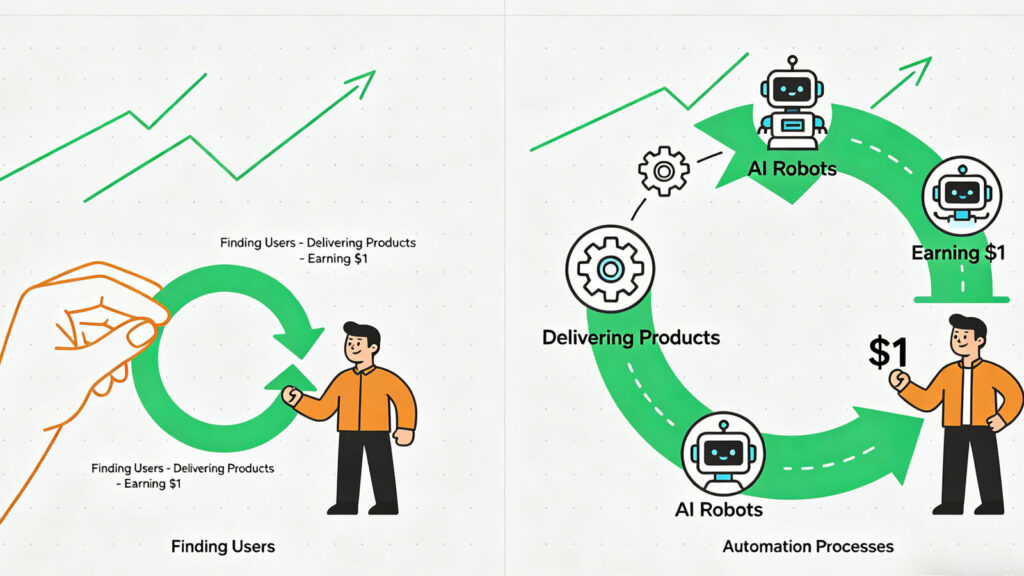
For the average person, survival trumps the grand narrative. Your first priority is to stay alive. Run a tiny value loop. Get a sliver of genuine commercial feedback. This is more valuable than any fancy business model.
Find your first ten real users. Earn your first dollar. Get your first repeat customer. Experience the first time someone seeks you out for collaboration because of your content or product. These milestones seem small, but they are critical. They build genuine confidence and prove, in tangible terms, whether your path is viable.
In my first year, I barely broke even. My goal was microscopic: earn an average of 300permonthforbasiclivingexpenses.Asmallpieceofviralcontentoranunexpected10 would excite me more than any corporate bonus. Looking back, that humble goal was essential. It calmed my impatience, helped me establish my own work rhythm, and built the mental stamina and patience I needed. Success as an OPC isn’t about initial explosive energy; it’s about steady momentum, building one micro-loop at a time, rolling it into a snowball.
4. Define External Value FIRST, _Then_Build Internal Automation
Many get excited about OPC and immediately jump into building complex workflows, agents, and automation—creating a legion of “AI employees.” This content is viral and looks impressive (I’m a fan, too). But for most beginners, this is putting the cart before the horse. You don’t lack automation tools; you lack a validated business loop.
Who is your customer? What specific problem do you solve for them? Why would they pay you? How do you deliver your product? What’s your pricing? If you haven’t answered these core questions, all your automation efforts are likely just sophisticated procrastination.
It’s like buying a top-of-the-line automated dishwasher before you’ve even figured out if your potential breakfast shop customers prefer noodles or dumplings. The machine is efficient, but you need customers first.
The sequence is non-negotiable: manually run a small loop first, _then_use tools to amplify it. “Manually” here doesn’t mean shunning AI entirely, but keeping human judgment in the driver’s seat.
This is where many modern AI tools provide incredible value: they let you test ideas with the market at near-zero cost. In the past, building a small tool, a quiz app, or a service page required hiring developers, lengthy back-and-forth, and weeks of waiting.
Now, low-code/no-code platforms have collapsed this timeline. Take V0 by Vercel, a popular no-code/rapid prototyping platform. It allows you to build and iterate on app UIs and web pages through simple prompts and conversation, generating functional previews in minutes.
A friend of mine identified a niche need and used a similar no-code tool to quickly build a utility that converts blog articles into optimized social media graphics. By easily integrating Stripe for payments via the platform, he now has over a thousand users and is turning a profit. He didn’t even worry about server deployment initially, using the platform’s built-in hosting and public URL.
Tools like these have already powered the creation of millions of applications. One entrepreneur used such a platform to build a market-fit app and earned a significant five-figure income. Another creator, with no coding background, developed a personality quiz app, sold it, and even packaged the process into a paid course.
Another friend, a stay-at-home parent and former designer with zero coding experience, now builds complete applications at night using intuitive, prompt-based tools. For the average person, the core value of these platforms is compressing the time to build a Minimum Viable Product (MVP) from weeks to hours or even minutes, allowing you to validate an idea on a shoestring budget.
5. Keep Humans in the Loop: Put AI in Its Rightful Place
Before fully automating a process, you _must_run through it yourself. The bottleneck of a one-person company is often the person themselves. If you don’t grow, you become the company’s constraint.
By manually navigating the full workflow, you discover the real user pain points, execution bottlenecks, and the specific details clients truly care about in your deliverables. You learn which tedious tasks to automate, which creative tasks to augment with AI, and which critical quality checks demand your personal touch.
AI is powerful, but it’s not a magic bullet or a hands-off manager. It makes errors, “hallucinates” convincing but incorrect information, and can’t replace core business judgment.
My own operational logic is simple: Automate the repetitive. Augment the creative with AI. Personally oversee the critical. AI is there to amplify you, not replace you entirely.
6. When AI Flattens Efficiency, What’s Your Moat?
This is perhaps the most crucial piece of advice. In the early days, the advantage goes to those who use AI first. In the mid-phase, it’s about who uses it better. In the long run, the battle shifts to why people choose you.
As AI becomes as ubiquitous as electricity, efficiency alone ceases to be a differentiator. When everyone can produce high-quality output quickly, what becomes truly valuable? What is your unassailable moat?
Many think AI lowers the barrier to entry, creating opportunity. In reality, AI simply moves the barrier. It shifts from “Can you build it?” to “Once built, will anyone know about it or trust it?“
I believe the moat lies in areas AI cannot replicate (focus on what AI _can’t_do):
- Domain Expertise: Your deep, nuanced understanding of a specific vertical is irreplaceable. AI can’t intuit an industry’s true pain points. A ten-year veteran and a new graduate using the same AI will produce vastly different outcomes.
- Distribution & Audience: In a world of product abundance, attention is the ultimate scarce resource. Owning your audience and channels to connect with customers is more powerful than ever in the AI era. Building is easier; being seen is harder.
- Trust & The “Human Touch”: Why does the same sentence carry different weight from different people? AI can generate content, but it cannot build trust with users. Trust begins with the sense of a real, living person. This can only be cultivated over time through authenticity and consistency.
For me, maintaining this public account is not just about content distribution. It’s a container for沉淀ing professional knowledge, showcasing a personal viewpoint, connecting with a target audience, and laying the groundwork for future opportunities. Every article is not just expression; it’s an accumulation of trust equity.
I’m increasingly convinced that running an OPC isn’t just about managing a business—it’s about intentionally building and operating “You” as a brand.
Bonus Advice 7: Always Have a Plan B
Finally, a crucial reminder: Always keep a Plan B.
Don’t treat OPC as an escape hatch from workplace pressure or a last-resort lifeline. The failure rate for startups is high, and the risks for a solo founder are even more complex.
You must ensure that through the process of building your OPC, you, as an individual, are becoming more valuable. Even if this specific project fails, your skills, industry knowledge, practical experience, and market value should have increased. That is your real safety net.
The safest, most worthwhile investment you can ever make is in yourself. When I quit my job, I had a fallback plan: I would dive deep into AI, share my learnings publicly to build an audience and skills, knowing that at worst, I could return to a corporate role with significantly enhanced capabilities.