

People feel exhausted using AI tools because AI removes cognitive breaks, triggers perfectionism, and amplifies unclear thinking; effective AI use requires clear prior thinking, and true competitiveness lies in independent thought.
Have you ever had this experience?
You’ve subscribed to several AI tools, switching between platforms all day. You spend two hours having AI draft an article, only to find the final result worse than if you’d written it yourself. You use AI to create a plan, but upon execution, you realize the direction is completely wrong, forcing a restart.
You’re busy all day, your mind racing, yet you feel like nothing substantial has been accomplished.
You might think it’s because you haven’t mastered AI well enough.
But I know many people—they’ve taken plenty of courses, subscribed to numerous tools, yet still feel this way.
This isn’t your problem. Three things are working against you simultaneously.
1. AI Has Stolen Your Only Breaks at Work
Your work used to contain many “low-cognitive” tasks—organizing documents, searching for information, formatting tables, copying and pasting.
These tasks were time-consuming but not mentally draining. To some extent, they served as cognitive breaks in your workday.
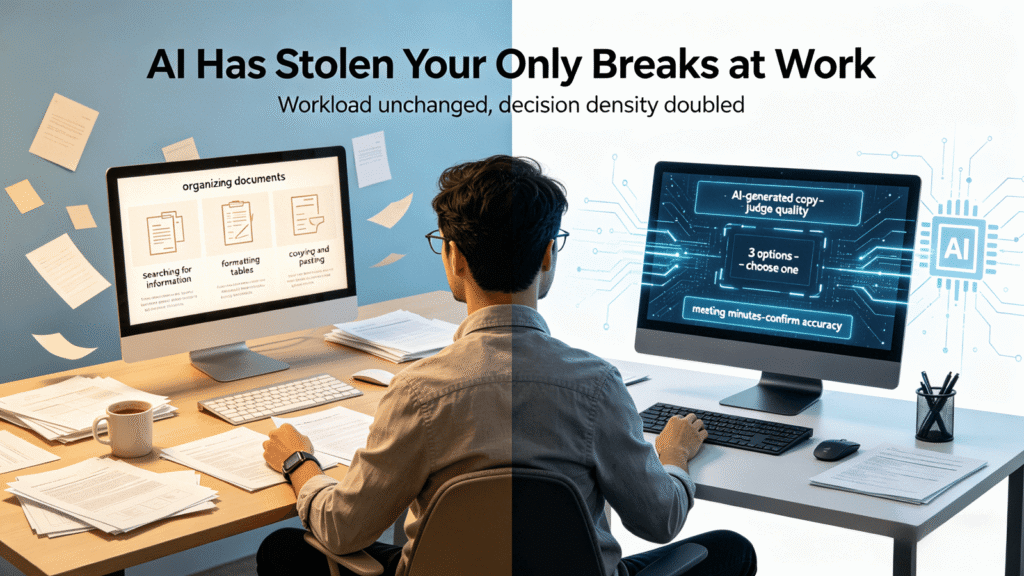
Now, AI has taken over all of these. What remains in your work is almost entirely judgment and decision-making:
- The AI generates copy, and you judge if it’s good.
- It provides three options, and you choose which one.
- It compiles meeting minutes, and you confirm their accuracy.
The workload hasn’t decreased, but the density of decisions has doubled.
Notice? AI has deleted all the breaks from your work, leaving only the high-intensity parts, running non-stop.
No wonder you’re exhausted.
2. The Trap of Perfectionism and the Absence of Completion
Finishing an article used to mean it was done.
Now it’s different—AI can generate 10 versions for you to choose from, run A/B tests for you to analyze, and even produce short video scripts, social media posts, and Q&A platform answers on the side…
Theoretically, everything can be made better, more, and more complete.
Psychology has a term for this: “Lack of Completion.” When you can always see the possibility of “it could be even better,” you’re perpetually stuck in a state of anxious incompletion.
I’ve been through this phase myself. I once had AI revise an article seven or eight times. Each revision brought slight improvement, and each time I thought, “One more edit will make it better.” By the end, I couldn’t remember what I originally wanted to say.
I later set a rule for myself: Three AI revisions, then publish.
Knowing when to say “enough” is more challenging than mastering any prompt.
A core competency of highly effective people is knowing when to say “enough.” But AI has completely blurred that line.
3. AI is an Amplifier, Not a Thinker
A friend of mine, a brand strategist with over a decade of experience, started using AI for proposals last year. At first, it felt miraculous—input the requirements, get dozens of pages in seconds.
But three months later, she told me: “My daily output is now five times what it was before, but the valuable part might be less than before.”
She explained: “Before, when working on a proposal, I’d think for two days first—what problem is this brand really trying to solve? When are the target customers most conflicted? Once that was clear, I’d start writing, and the direction was basically set.
“Now? I have a vague idea and toss it to the AI. It quickly gives me something that looks professional. Then I start revising, only to realize the foundational logic is wrong, and I have to scrap everything. This cycle happens every day.”
She said something that stuck with me:
“AI is an amplifier. If you think clearly, it amplifies clarity. If you’re unclear, it amplifies confusion.”
That hits the core of it.
AI saves execution time, not thinking time.
Before, with an unclear idea, you’d realize it wasn’t working as you wrote, stop, and rethink. Now? AI quickly generates a draft for you. You spend two hours revising it, grow doubtful of your entire existence, and finally realize the initial direction was wrong.
The biggest trap of the AI era isn’t that AI is hard to use—it’s that AI magnifies your lack of clarity.
4. Slowing Down is the Real Speed
The people who use AI most effectively are often not the fastest reactors or the highest output generators.
Their characteristic is: they are slow.
Slow where? Slow _before_they act. They spend more time than others thinking things through clearly, then give the AI a very precise instruction, getting a result close to what they want in one go.
Those who grow increasingly tired using AI are usually the ones who—tell the AI to start immediately, get a result, revise it, feel it’s off, tell the AI to revise again, revise again, trapped in an infinite loop.
On the surface, they are constantly active, but in reality, they are just running in circles.
In the AI era, the competition for speed is over. AI will always be faster than you.
The real competition lies in whether, before you act, you can think a little more clearly, a little deeper, a little more accurately than others.
This step cannot be outsourced.
So I’ve set a rule for myself now: Before using AI, spend 10 minutes writing the core judgment on paper.
These 10 minutes are more valuable than the two hours that follow.
5. What is True Competitiveness in the AI Era?
Finally, I’d like to share a quote from Italian philosopher Giorgio Agamben in “What is the Contemporary?”:
“Those who are perfectly contemporary with their era, those who adhere perfectly to it in every respect, are not contemporary; precisely because, for that reason, they are not able to see it; they are not able to firmly hold their gaze on it.”
AI tools are updated weekly, with new “must-use magic tools” trending every month.
Those who chase after every new tool, using them most diligently and subscribing to the most—they might be the ones with the least “contemporariness.”
Because they are too attached to the tools themselves, they fail to see the real question of our era:
When execution has become so cheap, what are you truly thinking for?
AI cannot answer this question for you.