
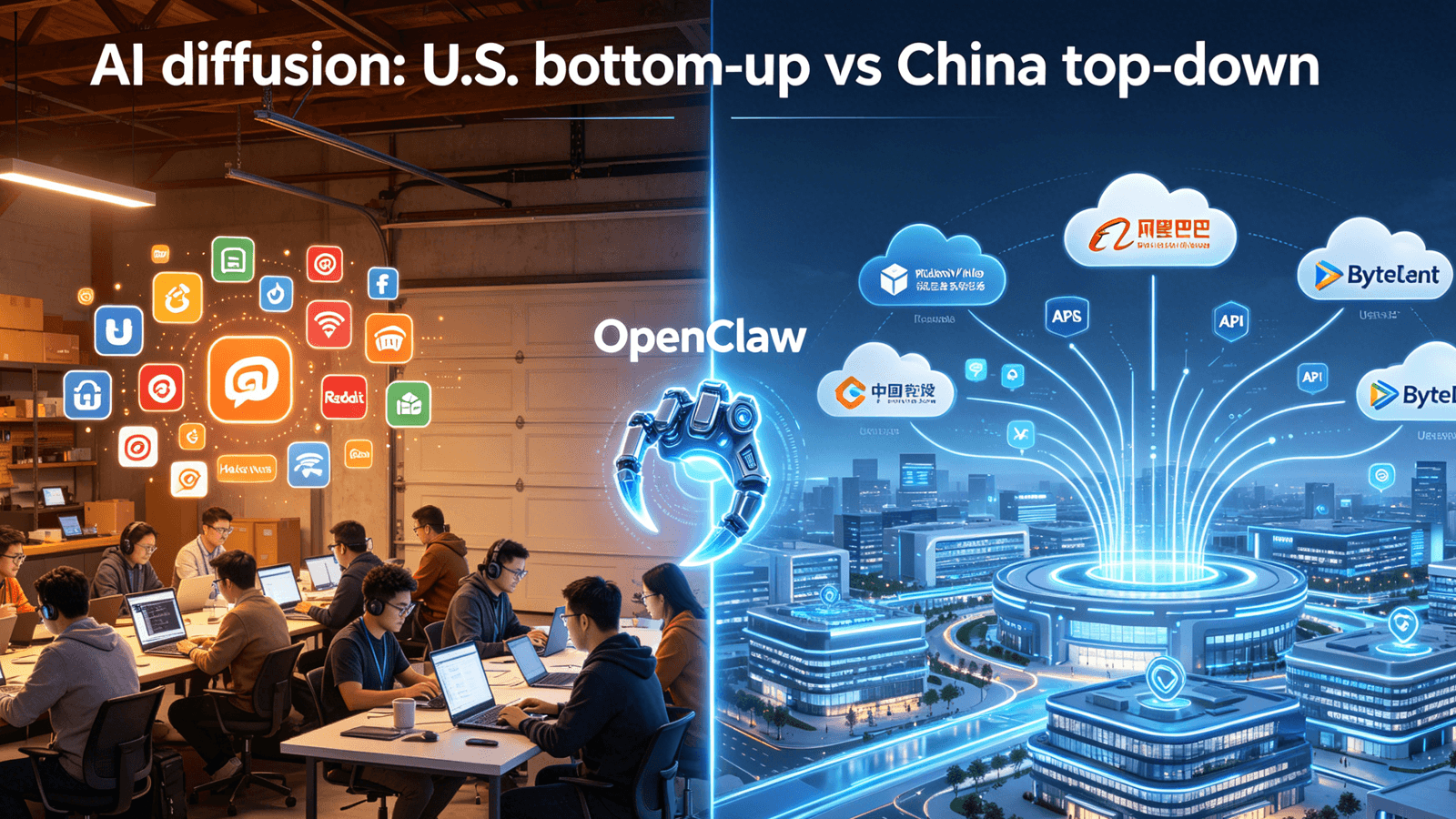
How the diffusion of AI technologies like OpenClaw follows opposite, mirror-image paths in the U.S. and China. It contrasts the U.S.’s bottom-up, grassroots-driven model of innovation with China’s top-down, platform-integration approach to scaling.This divergence is presented not as a mere market difference, but as a fundamental reflection of each society’s distinct cultural, political, and philosophical DNA.
OpenClaw began as an experimental project by an Austrian developer, Peter Steinberger, with a simple premise: “Make AI not just answer questions, but automatically complete entire sequences of tasks.” It went viral in Silicon Valley and subsequently ignited global interest.
What’s fascinating is that the diffusion paths for new AI technologies like OpenClaw in the United States and China are complete opposites, acting as a perfect mirror of each country’s political and cultural DNA. This isn’t merely a technical issue; it’s a true reflection of the underlying social, cultural, and political logic of both nations:
The U.S. relies on individual innovation bubbling up from below; China relies on platform integration permeating from above.
The American Model: A Bottom-Up Revolution
In the United States, stories like OpenClaw’s typically begin at the grassroots level. An independent developer or a small remote team discovers an open-source tool, finds it incredibly cool and useful, and starts tinkering—modifying code and adding features. They then release it for free on platforms like GitHub.
- Viral Adoption: The innovation spreads organically through communities on Reddit, Hacker News, and Twitter. Peer recognition, measured in stars and forks, fuels its rise.
- Corporate Catch-Up: Only after reaching a critical mass of hype do corporate giants like Google, Microsoft, and Meta take notice and scramble to follow up—through investment, acquisition, or integration.
The path is clear: Grassroots enthusiasts adopt first → Organic, viral spread within communities → Large corporations finally catch up and formalize. GitHub Copilot and Stable Diffusion are textbook examples of this model.

The Chinese Model: Top-Down Integration at Scale
In China, the dissemination path is completely inverted. The sequence is led from the top.
- Platforms Lead: Tech giants like Alibaba, Tencent, and ByteDance are often the first to detect the trend. They rapidly digest the core technology, optimize it, drive down costs, and package it into user-friendly, turnkey tools.
- Seamless Access: Developers and businesses don’t need to experiment from the ground up. They access AI capabilities seamlessly through APIs within ecosystems like WeChat Mini Programs, DingTalk, or Tencent Cloud.
- Tiered Rollout: Adoption follows a clear pattern: large enterprises first, then small and medium-sized enterprises (SMEs), and finally individual developers and general users.
The process is systemic: Major platforms invest and integrate first → Infrastructure is rolled out at scale → The market accesses it as a ready-made service. This enables proven technologies to achieve massive, rapid societal penetration.
Roots of the Divide: Culture, Politics, and Philosophy
The two models are not accidental; they are deeply rooted in each nation’s fabric.
The U.S. bottom-up model springs from:
- A culture of individualism and a “can-do” hacker ethos that glorifies risk-taking and tolerates failure.
- A decentralized political structure where the government’s role is largely supportive, funding basic research but avoiding top-down industrial planning.
- A market-driven ecosystem where private capital and startups lead, and innovation is filtered and amplified by the market itself.
China’s top-down model is fueled by:
- A collectivist cultural framework that prioritizes stability, efficiency, and holistic societal outcomes over individual distinction.
- A system of centralized coordination where national strategies, state funds, and policy guidance directly channel resources and align private sector efforts toward common goals.
- An excellence in rapid scaling and refinement “from 1 to 100” within established systems, prioritizing applied scale and efficient implementation.
Two Visions for the Future
The dichotomy presents a fundamental trade-off. The U.S. excels at foundational, “0 to 1” innovation but can struggle with fragmentation and uneven adoption. China excels at rapid, large-scale implementation and iteration but seeks to enhance its capacity for original breakthroughs.
In an era where AI is shaping the future, understanding these differences isn’t about declaring a winner. It’s about recognizing the distinct, deeply ingrained pathways of technological progress. The story of a tool like OpenClaw serves as a potent reminder:
Technology is never developed or adopted in a vacuum. It is always, inextricably, a product of the society that creates it.